In a world where user acquisition is getting more expensive and competitive, growth loops have become a powerful mechanism for businesses to drive sustainable, compounding growth. Unlike linear marketing funnels that end at a conversion, growth loops are cyclical systems where every user acquired can potentially bring in more users, creating a self-sustaining engine of virality and retention.
What Is a Growth Loop?
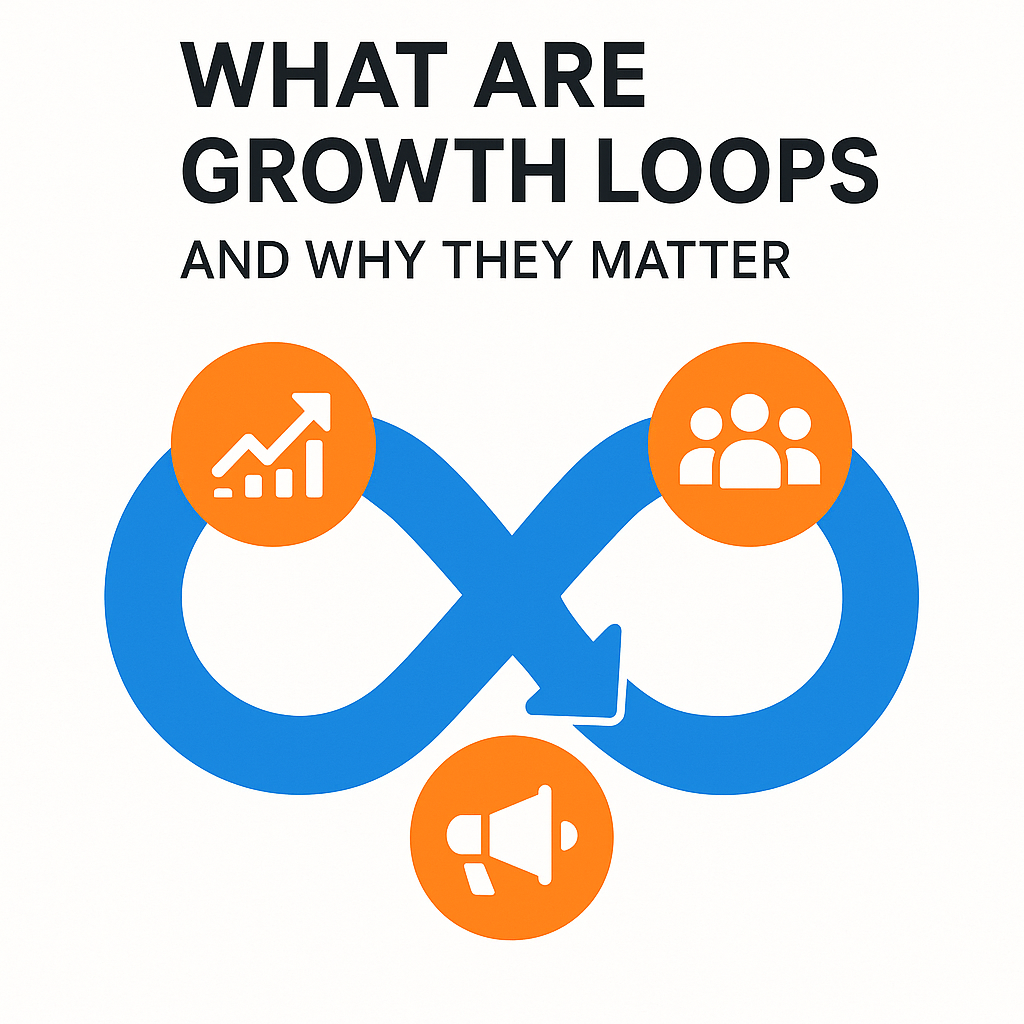
A growth loop is a feedback mechanism where an input (a new user or interaction) leads to an output (a new user or action), which in turn becomes the next input. These loops feed themselves, enabling continuous and scalable growth.
For example, in a referral loop:
- A user signs up.
- They invite friends via a referral link.
- Their friends sign up, get value, and invite more users.
This creates a compounding effect where each action generates more users or actions, increasing ROI without a corresponding increase in marketing spend.
Growth Loops vs Growth Funnels
| Feature | Growth Funnel | Growth Loop |
|---|---|---|
| Structure | Linear (Start to Finish) | Circular (Feeds Itself) |
| Goal | Conversion | Retention & Virality |
| Outcome | One-time acquisition | Continuous compounding |
| Example | Google Ads → Landing Page → Signup | Invite → Signup → Invite Again |
Types of Growth Loops
1. Referral Loops
Users invite others to the platform. Think Dropbox’s early growth — users received extra storage for every friend they referred.
2. Content Loops
Users create or share content that attracts more users. TikTok and YouTube are classic examples where user-generated content creates viral discovery.
3. Product Usage Loops
Product usage itself drives more usage. For example, Notion or Slack teams invite other team members to collaborate, expanding usage organically.
4. SEO Loops
Users generate content (like reviews, listings, or forums) which ranks in Google, driving more traffic. Think of platforms like Quora or TripAdvisor.
Why Growth Loops Matter
- Compounding Users
Growth loops compound over time, unlike ad-based growth which often plateaus when the budget runs out. - Lower CAC
Since users help acquire other users, customer acquisition cost (CAC) goes down significantly. - Sustainable Growth
Loops encourage organic user growth, making businesses less dependent on paid media. - Retention Built-In
Some loops (like product usage loops) are deeply tied to user retention, which increases lifetime value (LTV).
How to Build a Successful Growth Loop
- Identify Core Value
Your product must deliver real value that users want to share or repeat. - Insert a Sharing Mechanism
Whether it’s referrals, collaboration invites, or social sharing — make the sharing process frictionless. - Measure and Optimize
Track the inputs and outputs of your loop. Use metrics like viral coefficient, activation rate, and time to loop. - Automate Feedback
Design systems where the output automatically feeds the next cycle — this is where true scalability happens.
Real-World Examples
- Dropbox: Offered free storage for referrals — one of the most famous referral loops.
- Zoom: Product usage loop — users invite others to meetings, driving downloads.
- Airbnb: SEO loop — listings generate content that ranks in search engines.
- Notion: Team invites create exponential expansion inside organizations.
FAQs About Growth Loops
Q1: Are growth loops better than marketing funnels?
A: Growth loops aren’t necessarily “better,” but they’re more sustainable and scalable. Funnels focus on short-term conversions, while loops focus on long-term growth.
Q2: Do all businesses need growth loops?
A: Not always. However, businesses with digital products, network effects, or user-generated content benefit greatly from implementing growth loops.
Q3: How do I measure the effectiveness of a growth loop?
A: Key metrics include:
- Viral Coefficient (K-Factor) – how many new users each existing user brings in.
- Loop Completion Rate – the % of users who complete the loop.
- Time to Loop – how quickly the loop recycles.
Q4: What’s the difference between a viral loop and a growth loop?
A: A viral loop is a type of growth loop that focuses purely on user invites and virality. A growth loop can also include product usage, content creation, or SEO mechanics.
Q5: Can a company have multiple growth loops?
A: Absolutely. The best growth strategies involve stacking multiple loops that reinforce each other — like combining referral, content, and SEO loops.
Growth loops aren’t just a buzzword — they’re the foundation of modern growth marketing. By designing your product and user experience to feed back into itself, you can unlock long-term, compounding growth with less reliance on traditional marketing channels. Whether you’re a startup or a scaling brand, now’s the time to ask: How can I turn my users into my marketers?