If you’re running multiple paid campaigns, calculating ROI isn’t always straightforward. That’s where Marketing Efficiency Ratio (MER) comes in. MER gives you a top-down view of how efficient your marketing spend is across all channels not just a single campaign.
Unlike ROAS (Return on Ad Spend), which looks at channel-specific revenue, MER evaluates the total marketing effectiveness across your entire business. This article breaks down what MER is, how to calculate it, and how to use it alongside ROAS to make smarter decisions.
What Is Marketing Efficiency Ratio (MER)?
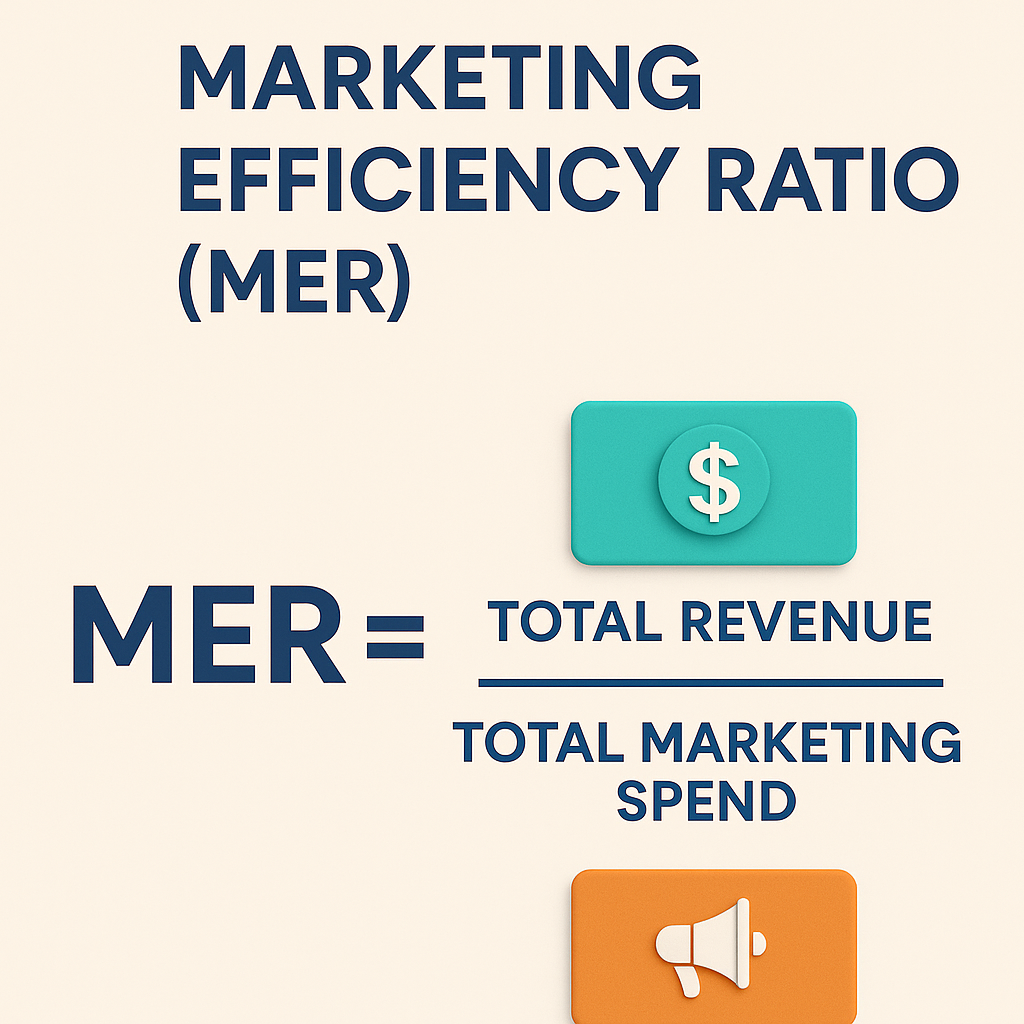
Marketing Efficiency Ratio (MER) is a performance marketing metric that measures the revenue generated for every dollar spent on marketing. It’s also known as Blended ROAS, because it considers total revenue divided by total ad spend, regardless of source.
MER Formula
MER=Total RevenueTotal Marketing Spend\text{MER} = \frac{\text{Total Revenue}}{\text{Total Marketing Spend}}MER=Total Marketing SpendTotal Revenue
Example:
If your brand made $500,000 in revenue last month and spent $100,000 on all marketing efforts (ads, influencers, email, etc.), then: MER=500,000100,000=5.0MER = \frac{500,000}{100,000} = 5.0MER=100,000500,000=5.0
This means you earned $5 in revenue for every $1 spent on marketing.
MER vs ROAS: What’s the Difference?
| Metric | Stands For | Measures | View Type |
|---|---|---|---|
| MER | Marketing Efficiency Ratio | Revenue / Total Marketing Spend | Holistic View |
| ROAS | Return on Ad Spend | Revenue / Channel Ad Spend | Channel View |
- ROAS is ideal for optimizing individual campaigns.
- MER is better for assessing overall marketing performance and profitability.
Why MER Matters in Today’s Marketing
- Tracks Blended Performance
With multiple paid and organic touchpoints, MER gives a bird’s-eye view of how all marketing efforts contribute to revenue. - Accounts for Attribution Blind Spots
Platforms like Meta and Google often over- or under-report conversions. MER avoids this by ignoring attribution biases. - Works Well Post-iOS14
Since iOS14 limited user tracking, MER became a trusted benchmark for performance across privacy-constrained environments. - Supports Scalable Decision-Making
MER helps you understand when to scale spend profitably. If MER drops significantly as spend increases, it’s a red flag.
How to Use MER to Optimize Strategy
- Set Baseline Targets
Determine your profitable MER threshold. For many eCommerce brands, it ranges between 3.0 to 5.0 depending on margins. - Monitor Weekly Trends
A declining MER might indicate rising spend without a matching rise in revenue a sign to pause or reallocate budget. - Pair MER with ROAS
Use MER to guide overall budget allocation, then use ROAS to fine-tune channel-level optimizations.
MER Benchmarks by Business Type
| Business Model | Healthy MER Range |
|---|---|
| DTC eCommerce | 3.0 – 6.0 |
| SaaS | 4.0 – 8.0 |
| Subscription | 2.5 – 5.0 |
| Info Products | 5.0 – 10.0 |
Note: These are general estimates. Your target MER should align with profit margins, CAC, and LTV.
Common Mistakes When Using MER
- ❌ Ignoring fixed costs (MER does not include product costs, salaries, etc.)
- ❌ Comparing MER directly to ROAS without context
- ❌ Not adjusting MER goals as business scales
FAQs About Marketing Efficiency Ratio (MER)
Q1: Is MER the same as ROAS?
A: No. MER is a top-down metric measuring total revenue divided by total marketing spend. ROAS looks at revenue per channel or campaign.
Q2: What’s a good MER?
A: It depends on your margins. For high-margin products, an MER of 3–5 is often sustainable. For low-margin businesses, a higher MER is needed.
Q3: How frequently should I track MER?
A: Weekly tracking is ideal to spot trends early, but monthly reviews are essential for strategic planning.
Q4: Does MER include organic traffic?
A: Yes, MER includes all revenue (paid + organic), but only the paid marketing spend.
Q5: Can MER help in budgeting?
A: Absolutely. MER helps determine how much you can spend profitably at scale.
The Marketing Efficiency Ratio (MER) is a powerful metric for modern marketers who want clarity over complexity. In an era of broken attribution and siloed platforms, MER keeps your focus where it should be on total profitability.
By tracking MER alongside ROAS, you’ll get a complete picture of what’s working, what’s not, and how to scale efficiently.