Not all website traffic is created equal. When dealing with cold traffic visitors who’ve never interacted with your brand before the stakes are higher. They don’t trust you yet, they’re not familiar with your product, and they’re probably not ready to buy. That’s why building a landing page that converts cold traffic requires a precise mix of strategy, persuasion, and testing.
In this guide, you’ll learn how to create high-converting landing pages specifically tailored to cold audiences, turning strangers into leads and leads into customers.
What Is Cold Traffic?
Cold traffic refers to visitors who come across your website or landing page without prior exposure to your brand. They’ve never purchased from you, don’t follow you on social media, and weren’t actively looking for your product. Often sourced from paid ads, search engines, or third-party placements, cold users require more warming up before converting.
Cold traffic contrasts with:
- Warm traffic – users who know your brand and may have visited before.
- Hot traffic – highly engaged users ready to convert.
Why Cold Traffic Requires a Unique Landing Page Strategy
A typical landing page designed for warm audiences might rely on brand loyalty or existing trust. But with cold traffic, your goal is not just to sell but to build trust fast.
Why? Because:
- Cold users have short attention spans.
- They are skeptical.
- They need more education and social proof.
- They need a clear next step.
A cold-traffic-optimized landing page removes friction, answers objections upfront, and presents a clear, low-risk call to action.
Essential Elements of a Cold Traffic Landing Page
Here’s a proven framework to turn cold visitors into warm leads or customers:
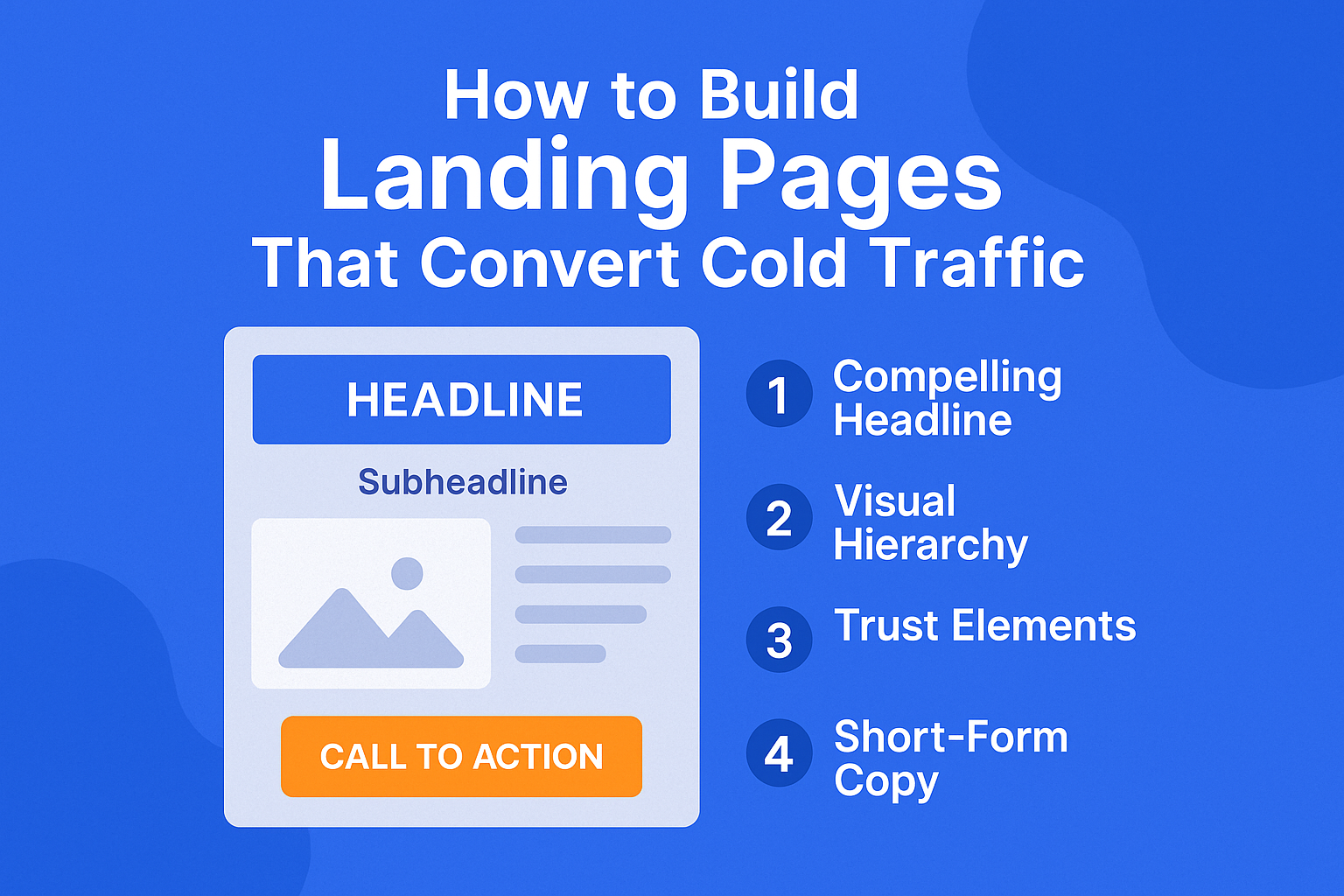
1. Compelling Headline with Value Proposition
Your headline should instantly answer:
“What is this and why should I care?”
Tips:
- Use numbers or emotional triggers.
- Focus on benefits, not features.
- Make the value clear in under 5 seconds.
Example:
“Lose 10 Pounds Without the Gym Try This At Home Plan That Works”
2. Subheadline That Reinforces Trust
The subheadline should:
- Support the main value proposition.
- Add detail or proof.
- Address the target audience directly.
Example:
“Used by over 30,000 women who hate dieting but love results.”
3. Visual Hierarchy That Guides the Eye
Use:
- Clear font sizes and whitespace.
- Visuals that show outcomes (not just products).
- Arrows or design flow to lead users to the CTA.
4. A Clear and Singular CTA (Call to Action)
Avoid overwhelming cold users with too many choices.
Examples:
- “Get the Free Guide”
- “Start Your Trial”
- “Claim Your Offer Now”
Make it:
- Prominent
- Repeated (at least 2–3 times)
- Matched to the offer’s level of commitment
5. Short Form Copy with Skimmable Layout
Cold users skim. Use:
- Bullet points
- Short paragraphs
- Icons and bolding for key info
Focus copy on:
- Benefits
- Emotional triggers
- Solving pain points
6. Trust Elements (Social Proof, Badges, Reviews)
Cold traffic won’t trust you unless you prove others already do.
Add:
- Customer testimonials
- Trust badges (certifications, money-back guarantee)
- Media mentions
- Video reviews or screenshots
7. Risk Reversal
Reduce perceived risk by:
- Offering a money-back guarantee
- Offering a trial
- Saying “No Credit Card Required”
- Adding a “Cancel Anytime” clause
Structuring a Cold Traffic Landing Page: Template
| Section | Purpose | Tips |
|---|---|---|
| Headline + Subhead | Grab attention, promise value | Clear, bold, benefit-focused |
| Hero Image/Video | Visually show the result or product | People-focused visuals work best |
| Benefits Section | Educate and persuade quickly | Use bullet points |
| Testimonials | Build instant credibility | Include real names/photos if possible |
| Offer CTA | Get the user to take a small step | One clear button with persuasive microcopy |
| Guarantee/Proof | Eliminate risk and objections | Trust badges, refunds, case studies |
| Repeat CTA | Final chance to convert | Sticky or footer CTA works well |
What to Avoid When Targeting Cold Traffic
- Too much information: Keep it lean and laser-focused on the action.
- Asking for too much: Don’t ask for credit cards upfront or personal info unless the value is sky-high.
- Multiple CTAs: Confuses and dilutes focus. Stick to one goal per page.
- Jargon: Speak like your customer, not like a marketer.
- Assuming trust: Cold traffic doesn’t know you don’t act like they do.
Optimizing for Conversions
1. A/B Test Elements
Start with:
- Headline
- CTA text
- Hero image
- Layout (long-form vs short-form)
2. Use Heatmaps + Scroll Data
Track:
- Where people click
- What they ignore
- How far they scroll
Tools: Hotjar, Crazy Egg, Microsoft Clarity
3. Speed + Mobile Optimization
Most cold traffic comes from mobile ads or organic discovery. Ensure:
- Fast load time (<3s)
- Responsive design
- Clickable buttons
4. Offer Personalization (Where Possible)
If coming from ads, match the landing page with:
- The ad’s copy and promise
- The user’s intent (use UTM tracking to segment)
Real World Examples of Cold Traffic Landing Pages
Airbnb – Host Signup Page
- Headline: “Earn money as an Airbnb host”
- CTA: “Start Hosting”
- Social proof: “Trusted by millions”
- Short copy, personalized earnings calculator
Grammarly – Free Account Page
- Headline: “Make Your Writing Clear and Concise”
- Subheadline: “Join over 30 million writers who use Grammarly”
- CTA: “Get Grammarly It’s Free”
- Trust badges, ratings, testimonials
Bonus: Cold Traffic Offers That Convert Well
If you’re building a cold traffic funnel, here are low-barrier offers that typically perform best:
- Free eBooks or guides
- Free trials (no credit card)
- Discount codes
- Quizzes (lead-gen tools)
- Webinars
- Contests or giveaways
Make sure your offer solves a pain point or satisfies curiosity.
FAQs
1. What’s the difference between a cold and warm audience?
A cold audience has never interacted with your brand. A warm audience has shown some interest—like visiting your site or following you on social media.
2. How long should a cold traffic landing page be?
Short to medium-length usually works best. Use concise, benefit-driven copy with strong visuals. If more education is needed (like SaaS), consider a longer format.
3. Should I use a video on a cold traffic landing page?
Yes, if it’s short and compelling. A 30–90 second explainer or testimonial video can quickly build trust.
4. What’s the best CTA for cold traffic?
Low-commitment CTAs like “Get the Free Guide,” “Start Free,” or “See Pricing” are ideal. Avoid “Buy Now” unless you’re offering something impulsive.
5. How can I warm up cold traffic after the landing page?
Use email drip campaigns, retargeting ads, and remarketing sequences to keep the relationship alive and build trust over time.