advertising analytics

How to Use Predictive Analytics in Campaign Planning

How to Use Predictive Analytics in Campaign Planning

Why Predictive Analytics Is Changing Marketing Forever Marketing has always relied on one part data, one part creativity, and one part intuition. But as digital channels multiply and customer journeys become more complex, gut feeling isn’t enough. Businesses that win today are those that can anticipate customer behavior before it happens and act on it. That’s where predictive analytics marketing comes in. By using historical data, machine learning models, and statistical algorithms, marketers can forecast trends, identify high-value segments, and optimize campaigns before they even launch. The result? Higher ROI, lower wasted ad spend, and campaigns that feel like they’re reading your customer’s mind. In this detailed guide, we’ll explore: 1. Understanding Predictive Analytics Marketing 1.1 What Is Predictive Analytics? Predictive analytics uses historical data combined with statistical algorithms and machine learning techniques to forecast the likelihood of future outcomes. In marketing, it’s used to: Example: If your e-commerce store has years of transaction data, a predictive model can help forecast which customers are likely to buy during the holiday season — allowing you to send them targeted promotions. 1.2 Difference Between Descriptive, Diagnostic, Predictive, and Prescriptive Analytics Predictive analytics sits at the intersection of data science and marketing strategy, feeding insights into decision-making. 2. The Role of Predictive Analytics in Campaign Planning Predictive analytics transforms campaign planning by: 3. Steps to Implement Predictive Analytics in Campaign Planning 3.1 Step 1: Collect the Right Data Your predictive model is only as good as your data. Pro Tip: Implement a CDP (Customer Data Platform) to unify data from multiple sources. 3.2 Step 2: Clean and Prepare Data Before modeling, ensure: 3.3 Step 3: Define Campaign Goals Your campaign goals will dictate the type of predictive model you choose. 3.4 Step 4: Choose a Predictive Model Common Predictive Models in Marketing: 3.5 Step 5: Train, Test, and Validate the Model 3.6 Step 6: Apply Insights to Campaign Planning Model outputs can directly inform: 3.7 Step 7: Monitor and Refine Predictive analytics is not a one-and-done process. 4. Tools for Predictive Analytics Marketing Tool Purpose Best For Google Analytics 4 Predictive audiences & purchase probability Web & e-commerce campaigns HubSpot Predictive lead scoring B2B lead nurturing Salesforce Einstein AI-powered sales and marketing predictions Enterprise campaigns IBM Watson Studio Custom ML models Data science teams Python + scikit-learn Open-source predictive modeling Technical marketing/data teams 5. Real-World Examples E-commerce: Amazon uses predictive analytics to recommend products and anticipate demand for restocking. Subscription Services: Netflix predicts what shows you’ll enjoy next and uses it to drive personalized email campaigns. Retail: Target famously predicted a customer’s pregnancy before she announced it by analyzing her purchase patterns. 6. Common Mistakes to Avoid 7. Best Practices for Success FAQs Q1: How is predictive analytics different from AI in marketing?AI is a broad term that includes predictive analytics, which specifically focuses on forecasting outcomes using past data. Q2: What industries benefit most from predictive analytics marketing?E-commerce, SaaS, finance, retail, and healthcare see strong ROI from predictive targeting and personalization. Q3: Can small businesses use predictive analytics?Yes many tools like HubSpot and Google Analytics offer built-in predictive features without requiring coding. Q4: How much historical data is needed for predictive analytics?Typically 6–12 months of clean, relevant data is a good starting point. Q5: What’s the biggest challenge in predictive analytics marketing?Ensuring the accuracy and relevance of data, followed by translating insights into actionable campaigns. Predictive analytics marketing is no longer a futuristic concept it’s a present-day necessity. From enhancing audience targeting to maximizing ROI, predictive models give marketers a competitive advantage. The key lies in pairing quality data with the right models, tools, and a continuous improvement mindset.
Read more
Best Practices for Running Ads During Holidays

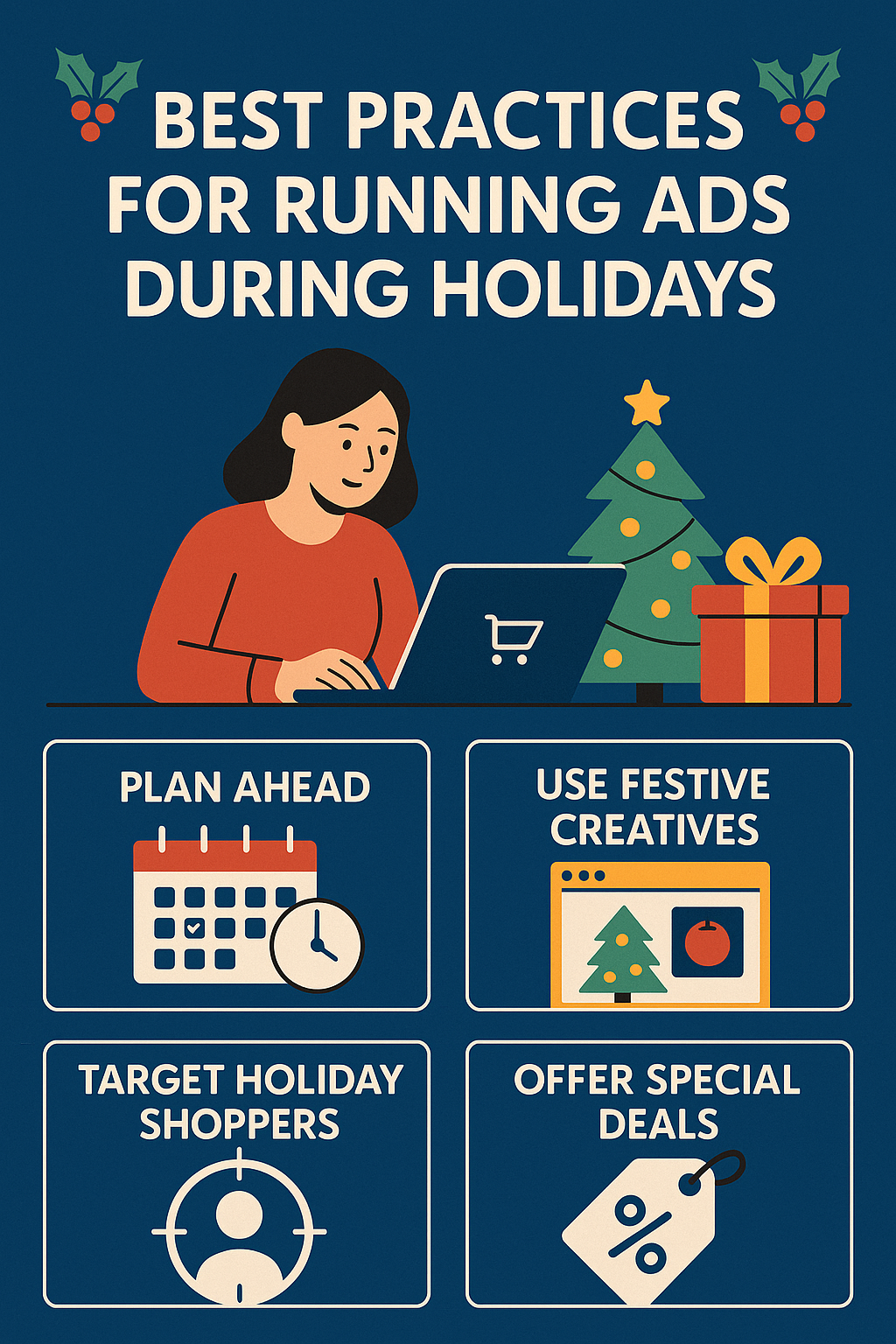
Best Practices for Running Ads During Holidays

Introduction: Why Holidays Are Prime Time for Advertising The holiday season—spanning everything from Black Friday and Christmas to Diwali and New Year’s—is a golden window for brands to drive sales, expand reach, and foster loyalty. But with heightened competition and consumer attention at an all-time premium, simply running ads isn’t enough. To win during the holidays, you need strategy, timing, and creativity. This guide walks you through the best practices for crafting and optimizing high-performing holiday ad campaigns. 1. Start Planning Early The best-performing holiday campaigns don’t start in December—they start in September or earlier. Begin with: Early planning allows you to test creatives, build anticipation, and avoid media cost surges closer to peak dates. 2. Refine Your Targeting Holiday shopping brings new behaviors and larger audiences. Use layered targeting strategies: Pro Tip: On platforms like Meta and Google, retargeting visitors who viewed products but didn’t purchase is especially powerful during holidays. 3. Create Holiday-Themed Creatives Holiday campaigns thrive on emotional connection. Adapt your creatives with: Consistency in visuals across platforms helps cement seasonal brand recall. 4. Optimize for Conversions Make sure your ad funnel is ready to convert: Use tools like A/B testing to compare offers, layouts, and creatives during the campaign. 5. Time Your Ads Strategically Peak performance days differ by region, holiday, and industry. Use analytics to: Bonus: Plan post-holiday ads for gift cards and New Year resolutions—there’s massive value even after the main event. 6. Track & Adapt in Real Time Don’t “set and forget” your holiday campaigns. Monitor: Make real-time adjustments to bids, creatives, or audience segments for maximum impact. 7. Leverage Emotional Storytelling Holidays are emotional. Your ads should reflect themes of: Story-driven ads (especially video or carousel formats) often outperform product-first creatives during this time of year. 5 Frequently Asked Questions (FAQs) 1. When should I launch my holiday campaigns? Ideally, 6-8 weeks before the actual holiday to build awareness, with performance peaks around 2 weeks out. 2. Should I increase my ad budget during holidays? Yes. Competition is higher, and cost-per-click increases, but so does buyer intent. Allocate more to retargeting and high-performing audiences. 3. Which platforms perform best for holiday ads? Meta (Facebook/Instagram) is great for storytelling and visual engagement, while Google Ads is powerful for search-based purchase intent. Use both if possible. 4. Do holiday-specific landing pages improve results? Absolutely. They improve relevance scores and provide a seamless user experience, often increasing conversion rates. 5. Should I offer discounts in my holiday ads? If it aligns with your brand. Limited-time offers, bundles, or free shipping tend to convert well during the holiday rush. Final Thoughts Holidays present a high-stakes, high-reward opportunity for brands. But success lies in preparation, personalization, and performance-driven execution. By following these best practices—from creative strategy to conversion tracking—you’ll not only stand out in a noisy market but also turn seasonal traffic into loyal customers.

Read more
Top Ad Creatives That Drive Clicks

Top Ad Creatives That Drive Clicks

In a digital landscape overflowing with content, your ad has milliseconds to grab attention. Whether you’re running campaigns on Meta, Google, TikTok, or LinkedIn, the right creative is the make-or-break factor between scroll-past or a click-through. In 2025, top-performing ad creatives aren’t just flashy—they’re strategically designed, deeply relevant, and powered by psychology, data, and AI insights. Here’s what today’s click-worthy ad creatives have in common—and how you can apply the winning formulas to your campaigns. Short-Form Vertical Video Ads Platforms like TikTok, Instagram Reels, and YouTube Shorts dominate attention spans. Vertical videos that are under 15 seconds, feature native-style edits, and lead with a clear hook in the first 2 seconds are outperforming other formats. What works: Bold Static Ads with Minimal Copy In-feed static images still work—when done right. The best-performing images in 2025 have: They’re designed for skimming eyes. No clutter. No confusion. Just clarity and punch. Ads That Tell Micro-Stories People don’t want products—they want solutions. Story-driven creatives win clicks by quickly showing the before/after, problem/solution, or a customer transformation. Examples: These ads evoke emotion, relatability, and curiosity. Text-Only Ads with Smart Copywriting Surprisingly, in-feed text-only ads on LinkedIn and Facebook often outperform visual-heavy formats—when the copy is compelling. High CTR text ads include: They feel more like advice or conversation than advertising, which builds trust. Interactive & Carousel Ads Carousel ads still drive strong CTRs, especially for: They let users swipe through a mini-journey. In 2025, top carousel creatives include AI-generated visuals, branded icons, and mini-narratives told over 3–5 slides. Hyper-Personalized Creatives With advanced targeting and AI, top-performing ads now dynamically adjust: If your ads still show the same creative to every audience segment, you’re leaving clicks on the table. Ads Built for A/B Testing The best ad teams don’t launch one hero creative—they launch dozens of micro-variations, test rapidly, and scale what wins. Test variables: The goal isn’t one perfect ad—it’s fast feedback loops. FAQs 1. What’s the average CTR for top-performing ad creatives in 2025?It varies by platform, but high-performing creatives typically get 2–4% CTR on Meta and 4–6% on LinkedIn or native display ads. 2. How often should I refresh ad creatives?For active campaigns, refresh creatives every 2–3 weeks. Ad fatigue is real—especially on Meta and TikTok. 3. Do I need a designer for every creative?No. With tools like Canva, Adobe Express, and AI-powered generators, even non-designers can build high-performing creatives. 4. Should I use AI to write ad copy?Yes—but always edit with a human touch. AI helps generate variations fast, but emotional resonance still needs a marketer’s eye. 5. What KPIs should I track for ad creative performance?CTR, cost-per-click, engagement rate, time spent (on video), and most importantly—conversion rate per creative. Final Thoughts In 2025, the best ad creatives aren’t just pretty—they’re smart, relevant, testable, and relentlessly user-focused. If you want your ads to drive clicks, start by asking:🔹 “Who am I talking to?”🔹 “What’s their pain point?”🔹 “How can I say more with less?”🔹 “What would make me stop scrolling?” Master those, and your clicks (and conversions) will follow.

Read more
Top Metrics to Track in Google and Meta Ads Campaigns

Top Metrics to Track in Google and Meta Ads Campaigns

In today’s competitive digital advertising landscape, running campaigns on Google and Meta (Facebook and Instagram) is essential—but what truly determines their success? The answer lies in the metrics. Tracking the right key performance indicators (KPIs) helps advertisers optimize strategy, allocate budgets wisely, and most importantly, drive conversions. If you want measurable growth from your campaigns, you need to know exactly what to monitor. Here’s a comprehensive look at the most critical metrics you should track in Google and Meta Ads campaigns. 1. Click-Through Rate (CTR) CTR is the percentage of users who click your ad after seeing it. It’s a strong indicator of how compelling your ad copy, image, or offer is. A higher CTR often correlates with a better Quality Score in Google and lower ad costs in Meta. Formula: (Clicks ÷ Impressions) × 100 2. Cost Per Click (CPC) This is the amount you pay each time someone clicks on your ad. Keeping CPC low while maintaining conversion quality is essential for ROI. 3. Conversion Rate Conversion rate measures the percentage of users who take a desired action after clicking your ad—like making a purchase or filling out a form. High conversion rates often mean that your landing page experience aligns well with the ad. Formula: (Conversions ÷ Clicks) × 100 4. Cost Per Conversion (CPA) CPA tells you how much you’re spending to acquire a single lead or sale. It’s vital for calculating your return on ad spend (ROAS) and ensuring profitability. Goal: Keep CPA lower than the lifetime value (LTV) of a customer. 5. Impressions & Reach These awareness metrics help assess brand visibility and campaign saturation. 6. Ad Frequency This metric tells you how many times a person sees your ad on average. High frequency can lead to ad fatigue and reduced effectiveness. Best Practice: Maintain frequency below 3 for most Meta campaigns. 7. Engagement Metrics (Meta Ads) Meta Ads provide detailed engagement insights like likes, shares, comments, and video views. These metrics help assess creative resonance and audience interest. 8. Quality Score (Google Ads) Google assigns a Quality Score to keywords based on expected CTR, ad relevance, and landing page experience. Higher scores reduce CPC and improve ad placement. 9. Return on Ad Spend (ROAS) ROAS shows the revenue you earn for every dollar spent on ads. It’s a direct indicator of campaign profitability. Formula: (Revenue from Ads ÷ Cost of Ads) 10. Bounce Rate & Time on Page These are tracked through your website analytics and indicate how well your landing page retains visitors. A high bounce rate might suggest a disconnect between the ad and the page content. FAQs 1. How do I choose which metrics to prioritize? Start by aligning your metrics with your campaign goals. If your goal is sales, focus on conversion rate and ROAS. For awareness, impressions and reach are more important. 2. What’s a good benchmark CTR for Google and Meta Ads? It varies by industry, but a CTR of 2-5% is considered healthy on Google. On Meta, anything above 1% can be a strong performer. 3. Why is ROAS more important than CPC? Because CPC only tells you cost, not return. ROAS considers both cost and revenue, providing a full picture of profitability. 4. Can I track offline conversions with Meta or Google Ads? Yes. Both platforms allow you to import offline conversions using tools like Google’s offline conversion tracking or Meta’s Conversions API. 5. How often should I analyze ad performance? Daily reviews are good for active campaigns, but deep analysis should be done weekly or bi-weekly to identify trends and make informed decisions. Final Thoughts Tracking the right metrics in Google and Meta Ads is not just about collecting data—it’s about making data work for your business. From CTR and CPC to ROAS and Quality Score, each metric tells a story. By understanding and leveraging these insights, marketers can craft smarter campaigns that drive real, measurable growth. Whether you’re scaling a startup or optimizing a corporate campaign, metrics are your compass. Use them wisely.

Read more
Contact us

Full-Service Data & Email Marketing Agency

Turn your marketing communications into a sales powerhouse and increase revenue with full-service email marketing.

Email us at: info@connectdigitalventures.com

Your benefits:

What happens next?

1

We Schedule a call at your convenience 

2

We do a discovery and consulting meting 

3

We prepare a proposal 

Request a Free Sample/Campaign Demo