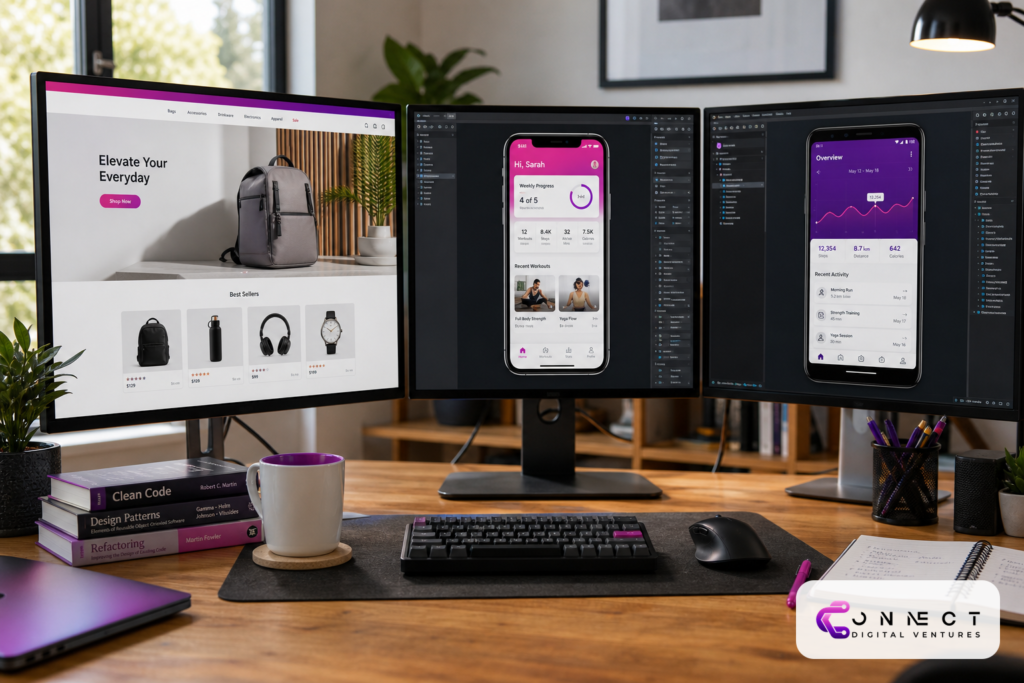
Customers no longer think in terms of “the website” and “the app.” They move between a phone, a laptop, a tablet and sometimes a watch or a car dashboard, and they expect every touchpoint to remember who they are, load instantly and feel native to the device in their hand. Businesses that meet this expectation are building next generation websites and apps: connected, fast, intelligent products that span the web, iOS and Android as one coherent experience. This guide explains what makes a digital product “next gen,” why the three major platforms must be planned together, which technologies matter, how to weigh native against cross-platform development, and how to choose an approach that fits your budget, timeline and goals. What Defines Next Generation Websites and Apps The simplest answer to the question “what separates next generation apps and websites from traditional digital products?” is this: traditional products are built as separate, static channels, while next gen products are built as a single, adaptive system. A traditional site is a set of pages published for desktops, and a traditional app is often a thin wrapper around the same content. A next gen product is designed around data, context and continuous improvement. Several characteristics recur across the best examples: Mobile-first architecture: Layouts, APIs, and data flows are designed for constrained screens, variable networks and touch input first, then scaled up to larger displays. Performance as a feature: Pages and screens respond almost instantly, even on mid-range devices and weak connections. Personalization: Content, search results, and recommendations adapt to behavior, location, and preferences. Offline and resilient behavior: Core tasks keep working when connectivity drops, and sync once it returns. API-driven design: A shared backend serves web, iOS, and Android, so features ship everywhere at once. Continuous delivery: Updates are small, frequent, measured, and reversible rather than large annual redesigns. Accessibility and security by default: Inclusive design and privacy protections are part of the foundation, not an afterthought. In short, next gen is less about a particular technology and more about a mindset: build once around the user’s journey, then deliver it intelligently to every surface. Cross-Platform Development: Why Web, iOS, and Android Matter Together Each platform plays a distinct role. The web is the most discoverable: search engines, social links and email campaigns all land there. iOS and Android deliver deeper engagement through push notifications, device sensors, biometric login, widgets and home-screen presence. Treating any one of them in isolation leaves gaps in the customer journey. Consider a retail example. A shopper discovers a product through a search result (web), saves it to a wishlist on their phone (app), and completes checkout on a laptop days later. If the wishlist, account, pricing and promotions are not consistent across all three, the experience breaks and the sale may be lost. This is the essence of an omnichannel user experience: continuity of identity, data and design across every channel. Planning the three platforms together also reduces cost over time. Shared design systems, shared APIs, shared analytics and shared content models mean that a pricing change, a new feature or a brand update is implemented once and propagated everywhere. This is a core component of any serious digital transformation strategy: the goal is not just to digitize processes, but to unify them so that data and experiences flow freely between channels. Market realities reinforce this. iOS and Android together cover essentially the entire mobile market, with Android dominant globally and iOS often stronger in North America, Western Europe, Japan and Australia, and among higher-spending users. Ignoring either platform can mean ignoring a large share of your audience, while ignoring the web means losing search traffic and frictionless first contact. Modern Frameworks and Technologies Powering Next Gen Digital Products The tooling landscape has matured significantly. Teams can now choose from several proven approaches, each with different trade-offs. Web technologies On the web, component-based libraries and meta-frameworks such as React with Next.js, Vue with Nuxt, Angular, Svelte and SvelteKit dominate. They support server-side rendering, static generation and edge rendering, which improve both speed and search visibility. Combined with responsive web design, using fluid grids, flexible images, container queries and sensible breakpoints, these tools let a single codebase adapt gracefully from a phone to an ultrawide monitor. Progressive web apps How do progressive web apps (PWAs) fit into a multi-platform strategy? They act as a bridge. A PWA is a website enhanced with a service worker, a web app manifest and HTTPS, which together enable offline access, installability, background sync and, on supported platforms, push notifications. PWAs are an excellent fit when: You want app-like behavior without app store friction or review delays. Your audience arrives primarily through search or links. Your budget favors a single codebase and fast iteration. PWAs do have limits. On iOS, access to some hardware features and background capabilities is more restricted than in a native app, and app store discoverability is lost unless the PWA is wrapped. For many content, commerce and productivity products, however, a PWA is a smart first step or a strong complement to native apps. Cross-platform mobile frameworks Cross-platform app development lets teams share most of their code across iOS and Android. Two frameworks lead the field: React Native development: Backed by Meta and built on JavaScript and TypeScript, React Native renders real native UI components. It is a natural fit for teams that already use React on the web, since developers, patterns and even some business logic can be shared. Its ecosystem is large, and its newer architecture reduces the old bridge overhead. Flutter framework: Backed by Google and built on Dart, Flutter draws its own UI with a high-performance rendering engine, giving pixel-level control and highly consistent visuals across iOS, Android, web and desktop. It is popular for brand-heavy interfaces and custom animation. Kotlin Multiplatform is another rising option, allowing shared business logic in Kotlin while keeping fully native UI on each platform. Native toolkits Native mobile development uses Swift and SwiftUI for iOS and Kotlin